Showing posts with label regarding druids. Show all posts

Friday, May 8, 2009

Mana regeneration and healing post 3.1

The great mana regeneration nerf of 3.1 was supposed to make mana conservation an issue again. I haven't really seen that though. The only changes I have made to my healing is weaving Nourish into the mix and letting my lifeblooms bloom and I finish Ulduar boss fights with 75% or more mana. Apparently, I am not the only one that has noticed it. Yesterday, Ghostcrawler said:

To be honest, despite all of the nerfs, mana regeneration still doesn't seem to be an issue for healers in Ulduar. You can often still afford to cast your largest heals and not care about overhealing because the risk of people dying feels like a far greater risk than running out of mana.

We're not sure that will lead to us making any additional nerfs at this time (and Replenishment would probably be the target if we needed to.) So far we're really happy with how the various fights in Ulduar feel. There are very intense moments (like Frozen Blows) but there are breaks as well (in between Mimiron phases for example). Many of the fights are dynamic -- you heal in one fashion at times (say MT healing) and then another fashion at other times (say raid healing during add moment or big AE spells). There aren't too many times where you're just spamming your spells every cooldown or GCD, and when it happens it's not necessarily for too long.

That said, we think we can still make healing more interesting. :)


Honestly, I think he is right. They can make healing more interesting. But isn't it stressful enough as it is? We are using every GCD available to us and people are still dying. Miss a taunt on Auriaya and your tank gets insta-gibbed, no matter how many HoTs he has ticking on him. Tympanic Tantrum ties my guts up in knots! And don't even get me started on Mimiron!

Another thing I have noticed in 3.1 is how much less significant HoTs have become. Or at least, that's how it feels to me. Our HoTs have always been overwritten to a certain extent, but they don't hardly tick any more. Things may be slightly different when we manage to get a 4-piece T8, I suppose and have that little extra buffer to play with.

Has anyone else noticed this, or am I imagining things?

Wednesday, April 29, 2009

Druids: cat form DPS

Since we started raiding Ulduar a couple of weeks ago, we have come across some problems. Not in the usual places, like healing and tanking, but in the more unusual arena of DPS. We were failing miserably on several DPS check fights (like Razorscale and Deconstructor), hitting hard enrages without being close to killing them. To address this problem, our raid leader recently made a general request of the guild to start forum threads covering DPS in its various forms with rotations, builds and other tips to begin educating our members and aleviating the problem. We are, after all, a casual guild that happens to raid, not anything close to a hardcore guild. That being said, we do have several members that know their classes very very well and are capable of providing guidance for the rest of us.

I decided to take the plunge and write what I knew about druids DPSing in cat form. Here is the result of that effort:

I don't pretend to be an expert at this, but I am getting more and more familiar with the inner workings and theorycrafting of druid dps in cat form as time goes on.

First lets talk about resources: everyone in this series of posts has mentioned Elitist Jerks and I need to give it a nod also. It is, hands down, the best, most in-depth forum for mechanics of any class out there. The only drawback it has is that it may be TOO complicated. The amount of theorycrafting and mathematically intense calculating on the various threads can scare away (with good reason) the more casual player. For those who feel that much of the information at Elitist Jerks is over their heads, there are a number of more approachable druid blogs that handle various aspects of druiding (TM). For cat dps, the foremost blog, in my opinion, is Karthis' Of Teeth and Claws. He speaks very candidly and clearly about the how to get the most out of your cat in many different situations. Due to the nature blogging, finding the answer to the exact question you have may require a little digging, but in most cases, the answers are there. Unfortunately, a few of his latest posts seem to indicate a degree of burnout, so the position of leading cat blogger may soon be vacated.

DPS as a cat is not what it used to be. We now have to juggle a lot of different abilities and are limited only by our energy regeneration. We can't just mangle-spam and expect to do well on the damage meters. And lets face it: when we are dpsing (unlike healing or tanking) our position on the meters is almost all that matters.

The abilities that we will be using to dps are: Mangle, Rake and Shred to generate combo points, Savage Roar, Rip and Ferocious Bite to use them up and Tiger's Fury to generate precious energy. The basic idea of dps as a cat is to get Savage Roar up and KEEP it up while keeping bleeds, dots and debuffs up as much as possible. While Mangle is not truly desirable for its dps potential, it *is* desirable for the debuff that it applies. If we have a feral druid tanking or another cat druid in the raid attacking the same targets, we may talk ahead of time to see whose responsibility it will be to keep Mangle applied to the targets. In the case of a beartank, they will want to be the one mangling because of the threat it is capable of generating. If there is only a second cat (and no beartank), then generally the one with lesser damage potential should be refreshing mangle.

Use Rake early and allow it to go almost its full duration before reapplying. The up front damage is low compared to the bleed aspect of this ability so we want to maximize energy usage by allowing it to go on as long as possible. As soon as the fight begins use Savage Roar as soon as possible, even if it only with a single combo point. That flat 30% increase in damage is too valuable to wait for 5 points. After that, Shred to 5 combo points, then Savage Roar again to get the 33 sec duration up. Keep using Shred, only stopping to reapply Rake or Mangle as necessary then Rip at 5 combo points. Keep juggling these abilites. If (i.e. when) you run out of energy, use Tiger's Fury to instantly regenerate 60 energy and keep going. If you reach 5 combo points and Rip still has a long time left (8 sec or more) and you don't need to reapply Savage Roar use Ferocious Bite instead. Unless you have the glyph of shred (which I don't yet) this should not occur very often at all.

All this requires carefully watching 1. Debuffs on the boss. 2. Buffs on you and 3. Energy reserves. There are a number of mods to help with this DOTimers is a mod originally developed for warlocks but works really well for cat druids. It shows the debuffs on the boss with countdowns showing how close they are to expiring. I think there is a way to make it show your own buffs as well, but haven't figured it out yet, so I am constantly looking at my own buff timers to see how long I have left on Savage Roar.

Use Berserk every time it is up. Use Berserk every time it is up. Use Berserk every time it is up. Use Berserk every time it is up. Use Berserk every time it is up.

In conclusion:

With beartank: Rake-->Savage Roar-->Shred-->Shred-->Tiger's fury-->Shred to 5 combo points-->Savage Roar-->Rake-->Shred to 5 cp-->Rip, refresh Rake, Savage Roar and Rip as necessary.

Without another mangler: Mangle-->Savage Roar-->Rake-->Shred-->Tiger's Fury-->Shred to 5cp-->Savage Roar-->Shred-->Rake-->Shred to 5cp-->Rip. Refresh Rake, Savage Roar and Rip as necessary.

Oh, and watch your threat...

Tell me what you all think.

Monday, April 27, 2009

Finding a new identity

That's what it feels like. I am still a druid. I am still a restoration druid. But I don't have a feel for how to play any more. I feel like a fumbling, bumbling idiot...

My usual Sunday/Monday 10-man group went to Ulduar yesterday. I used Rejuventation as my go-to heal while stacking all different HoTs on the tanks. Then using Nourish to keep them at max health. Pretty standard stuff. But looking at the WWS reports after the raid, I saw that my HPS took a massive hit from pre-3.1 numbers. And it's not all about Lifebloom. I just can't put my finger on what the problem is.

I was responsible for rooting the adds during the Ignis fight so I missed a lot of heals while we learned that fight. But I felt like my HoTs tick too slowly to make a difference and my direct heals were very sad by comparison to either our shaman or our paladin and I don't think either are geared as well as I am.

I wish I knew what I was doing wrong. I think of myself as relatively skilled and knowledgeable about the game and especially about my class. Last night was rather sobering. Perhaps I'm not as good as I thought I was and I was just coasting on an overpowered healing class.

Thursday, March 26, 2009

Tunnel Vision

Contrary to what some dpsers or tanks may think, healing is not easy. Most of the healing classes have several tools at their disposal to help them heal effectively. Syll, over at rollinghots.com recently wrote and excellent series of blog posts summarizing the healing tools and healing styles available to holy priests, discipline priests, restoration shaman and holy paladins. Those posts talk about how different we are. This post is going to touch on one of the major problems I have while healing. From my conversations with other healers, druids and otherwise, I gather that it is a more or less common issue for all of us. Tunnel vision. When you are locked into healing, you focus on a small part of your UI: the health bars of the raid, 5-man heroic group whatever. As time goes on, my field of vision grows smaller and smaller until all I can see are those little green (woe be upon us if they start turning orange or red) bars. This is all well and good in fights like patchwerk where movement is unnecessary. But there are bosses in the game that punish us for that.

For example, Sartharion with one or more drakes up harkens back to the more traditional "don't stand in stuff" raiding mentality. There is so much going on: void zones, flame waves, whelps, blazes. And each one requires a different action from the healers.

We were doing Sarth+2D a couple of weeks ago. I kept dying. Mostly it was only peripherally my fault: I had to catch up with a tank who was avoiding a falme wave so I ran through said wave or I had too many whelps on me because I didn't stand close enough to the tank's Death and Decay when they spawned; things like that. A handful of times though I died (and consequently wiped the raid - there is VERY little room for error Sarth+2D or +3D) because of stupid errors: I stood in a void zone, I was hit by a flame wave, I even wandered into Sartharion's breath weapon once. All that because of tunnel vision.

Since then, I have tweaked my UI to offer me a more focused view of the important parts of the raid area. My healing bars have moved closer to the center of the screen, my keybindings for things like barkskin and bear form have moved closer to where my left hand normally lies on the keyboard.

Last night we did Sarth+2D again. I did much better. We are still not quite there. Our healing is not quite enough to cope with an enraged Sartharion AND a drake up AND whelps AND blazes. Even with Ritavu and myself both cross-healing on both tanks, it was still not enough.

So what are the strategies some of the rest of you use to minimize the effects of tunnel vision? I can use all the help I can get...

Thursday, March 12, 2009

Living Seed: Should I spec into it?

Given the changes coming in patch 3.1 and the increase in the value of critical heals for restoration druids, I thought it might be time to talk about this little talent buried deep down in the restoration tree.

As you can see, it takes 35 talent points in the restoration tree to open up the possibility of putting any points into Living Seed. That's a fairly sizable investment of points and indicates a dedication of the character to healing virtually full time. So, like so many others on this blog, this is a post dedicated to restoration druids.

In the last few weeks, I have read a couple of druid bloggers that have mentioned it and debated its merits and flaws. One supported it and one decided it was not worth their time. Unfortunately, I don't remember where I found those opinions. If someone can point me back to them, please let me know as I would really like to link to them in this post.

What follows is a rough analysis of how I feel about Living Seed. During an average raid of Naxxramas, Living Seed generally accounts for between 0.7% and 1.4% of my total healing done.

The stats above came from our latest foray into the Dread Citadel and include all the boss fights for the plague, construct and death knight wings. As you can see, Living seed is responsible for almost exactly 1% of the healing I did on that fight. This much is obvious to the casual observer.

Another thing that is important to note is how low overhealing is for Living Seed. Only 6% of the total healing by it was lost to overhealing. This is important because the heal is actually triggered by damage. So, if it is ticking on a character and they take damage, some (or all) of that damage is immediately restored.

Digging down into the numbers, we can see that it came into play twenty-six times and healed for an average of 1,879 with a maximum of 2,839. The interesting thing comes when comparing that to the number of crits that I had over the same time span. Regrowth crit 58 times for an average of 7,402 while Swiftmend crit 3 times for an average of 11,268. Nourish never crit and I didn't use Healing Touch.

Wait a minute... I crit sixty-one times on heals that qualify for Living Seed and only saw twenty six instances of Living Seed actually healing someone? Yes. And it makes sense if we think about it for a moment. The buff gained by the target when one of our healing spells crits on them lasts only fifteen seconds. If they do not take any damage in those fifteen seconds, the buff fades and the potential healing is lost. Still, only 42% of potential healing happened. Is this good? Well, your mileage may vary. On the particular run we are discussing, I was mostly assigned to raid healing. A druid principally assigned to heal tanks would have a much higher percentage of their crits converted into efficacious Seeds.

Another thing to notice is that the size of the Living Seed heals does not seem to jive with the size of the crits. An average Swiftmend of 11,268 would account for a Living Seed of 3,380. But the data shows that the largest heal I got from a living seed is 2,839. Why is that? It's not overhealing. That would have been reported as such. Well, one of the hidden aspects of the talent is that Living Seed only gets 30% of the amount of the heal that lands and nothing to account for overhealing. Frankly, I think this is unfair, as many crit heals are going to be partially overhealing anyway.

And then I noticed a little note, hidden deep inside the 3.1 patch notes:

So, this problem will no longer rear its ugly head once patch 3.1 goes live. Good!

What does all this mean to us restoration druids? I can't answer that. It depends on individual playstyles and individual conceptions of druid healing. Here is what it tells me: Living Seed is currently a marginal choice for three talent points. When patch 3.1 goes live, it will become slightly stronger, slightly more useful, especially to tank healers, a little less so to raid healers. Crititcal strike rating is still not going to be something that a restoration druid will want to stack, just an incidental marginal benefit from the gear that we choose to get our mainstays: spirit, spell power and mana per 5. Averna had an exceptional post on her blog comparing haste to crit and their value to resto druids. You can find that here.

So what do you all think? Is Living Seed worth it? Why? Why not?

Tuesday, March 10, 2009

The great Lifebloom nerf of 3.1

Please take this post with a grain of salt. I think I may be overanalyzing things that may or may not translate into the live realms.

So what are we supposed to do? How are we supposed to heal? Tell us Blizz! Every time we think we have it figured out you turn us on our noses and tell us we are doing it wrong.

Single stacks of Lifebloom were a PvP tool. The one that made the resto druid the most feared creature in pre-wrath arenas. No matter what you did, that bloom was going to heal your target and there was nothing you could do about it, short of bursting him/her down or switching to another target.

Triple stacks were the purview of tree druids in PvE. Stack them on the tank and keep them rolling. Do not let them bloom. Do not collect $200. It provided a good amount of HPS (healing per second) and an amazing amount of HPM (healing per mana) giving us both throughput and efficiency. when WotLK hit and we all levelled our healers to 80, we found that higher ranks of lifebloom were not quite as efficient, but still provided both benefits they had enjoyed before. Coupled with a newly useful Regrowth and a recently nerfed, but still useful Wild Growth we learned to respond to burst damage and group damage in raids as well as only bufferring against it.

Enter the great lifebloom nerf of 3.1, stage left. Suddenly, our most efficient heal becomes our least efficient one. Suddenly, the dreaded bloom - the very thing we conditioned ourselves to avoid at all costs - becomes another tool in an already complex arsenal of healing tools. Suddenly, lifebloom in PvP gains a new life and becomes three times more powerful, at the significant cost of its efficiency.

So, I ask again: how are we supposed to heal? Obviously, the Blizzard game developers have something in mind for the druid. But what is it? We are no longer the rolling tank healer that we used to be. The 6-second cooldown on Wild Growth suggests we aren't supposed to be a full-time AoE raid healer. Rejuvenation ticks way too slowly to be an effective response to damage with any kind of burst potential, but can be used, in conjunction with other HoTs as the buffer it has always been thought of. Unglyphed Healing Touch is too slow and too expensive to use continuously and Nourish without a 4-pice Tier 7 set bonus is mediocre both in throughput and efficiency, as Phaele showed in her excellent breakdown a few months ago.

The answer, I think, lies in a combination of all the spells we currently have access to. Will we be the powerhouses of old? No, probably not. We can, if we so choose, continue to roll lifeblooms on tanks, but will face the prospect of spending the second half of any boss fight staring at an empty mana bar. No. Stacking lifebloom will no longer be the answer. Throw single lifebloom stacks around in the raid in a sort of fire-and-forget manner may be more forgiving since their ultimate blooms (whether they heal or overheal) will restore a portion of our mana.

I think the ultimate winners from this nerf will be restoration druids that heavily favor PvP. Their healing is going to see a jump in an arena where efficiency, though still important, takes a back seat to throughput. For the rest of us, Lifebloom in conjunction with a newly crit-friendly Nourish and Rejuvenation, as well as the occasional Regrowth, will characterize our new reactive style of healing and contrast sharply with the proactive approach we were always known for. Time will tell.

Monday, December 15, 2008

Loken is toast!

I owed him. Last time I went to heroic Halls of Lightning the bastard made me look bad. But revenge, as they say, is a dish best savored cold.

Lets get a bit of background on this. As far as lore goes, Loken is one of the titans (i.e. creators of all the world) and leader of the Iron Dwarves in Northrend. At some point, he bacame disillusioned with the pantheon and was swayed by Yogg-Saron, one of the old gods. He is a big part of the troubles that have brewed in Storm Peaks and one of the reasons the earth giants there (Vanir, also known as Sons of Hodir) are at war with the Storm Giants (Aesir

In game terms, he is the last boss in Halls of Lightning, the higher level of the two five-man instances in Ulduar. He is also responsible for killing more players than any other boss, even those in Naxx - Patchwerk makes #6 on the list. So what does he do that makes him so lethal?

Well, a couple of things. Three actually:
  1. His first ability is called Lightning Arc. It is a stacking debuff that does damage to the target and has a chance to apply the debuff to any other characters within a short range.
  2. Then there is Pulsing Shockwave. This is a damage wave thatpulses every three seconds and does more and more damage the further one wanders from the boss.
  3. His last ability is his most lethal one: Lightning Nova. Every thirty seconds, he will start casting this spell. Once he is finished, everything within a 15 (or maybe 20?) yard range of him is generally annihilated.
So all these abilities combined mean you shouldn't stay close to him and yet you shouldn't get too far away from him either. Of his three abilities, Lightning Nova is easily the most devastating. Anyone caught in it will be lucky if they are left with anything more than a sliver of health and will need immediate, blow-every-cooldown healing to stay alive long enough to get back to where they are supposed to be because of the Pulsing Shockwave.

The strategy I have found works the best is this: ignore the Lightning Arc. That's right. Ignore it. Stack on top of each other. The other characters are your friends. The healer is your BEST friend! Most healers will be able to use multi-target heals (chain heal, circle of healing, wild growth) to keep everyone alive through the damage done by the Lightning Arc. While he channels Lightning Nova everyone needs to move TOGETHER in the same direction to get out of it. If one person goes in a different direction, they will likely die to the Pulsing Shockwave. Staying together accomplishes a couple of things. Everyone stays in range of multi-target heals and it minimizes the time spent in range of the Pulsing Shockwave since, upon finishing his casting, the boss runs to the tank just as the tank runs to him. Rinse and repeat until Loken bites the dust.

Other than encounters where sheer damage output absolutely crushes gear level (Lady Vashj, anyone?) this is, hands down, the most difficult encounter to heal that I have encoutnered in the game. I imagine it would be even more challenging for a healer that cannot heal on the run (the way tree druids can) like a restoration shaman or a holy paladin.

Wednesday, December 3, 2008

Restoration druid itemization


I'm not sure if I'm back yet. I was looking at some spreads in Wowhead trying to decide what items held the most value for me as a restoration druid as we progress through 10-man Naxxramas and stumbled across an oddity in the itemization for druids.

There seems to be an issue here: there are exactly 3 items at level 200 (item level that drops in 10-man Naxxramas) that do not have wasted stats on them for a resto druid. Only one of them is leather: the tier 7 helm that can be exchanged for the token that drops for Kel'thuzad. The other two are cloth (one priest-only).

What am I calling wasted stats? Haste, crit and hit rating are wasted stats, in my opinion. Haste and crit are not *truly* wasted since they do modify our stats, but their value is minimal when compared to mp5, spirit and spell power. And it seems that the vast majority of items, whether meant for dps casters or healers sports *either* spirit *or* mp5. Not both, except in the very rare occasions I mentioned. Instead, copious amounts of +haste, +crit and +hit are applied to items: in the same subset of items (ilvl 200 items) there are 19 that sport spell power, spirit and haste and 26 that have spell power spirit and critical strike rating.

This isn't a post whining about druid itemization. The point I am trying to make is that Blizzard obviously thinks we should be stacking something on our gear *other* than what I had thought we needed to be stacking. But what? What is our playstyle supposed to be? A session in Naxx last night showed me that we will be spending very little time outside the 5 second rule. And given that our spells cost more, there is no more chain potting, mana becomes an issue that it never was in BC.

Perhaps what we are supposed to do is separate our spirit from our mp5. There are 16 items that have spell power and mp5 without spirit (including a fair amount of duplication: 3 rings, 3 cloaks, 2 helmets and 2 chestpieces) but fewer than that are not more appropriate to other classes than healing druids and priests (and lets be realistic: no raid is going to look kindly upon looting an item with +hit (for example) to a healer when a dpser can use it, and for good reason).

There is a large number of items that have spirit and spell power so stacking spirit is not going to be a problem. But since we will be spending less time outside the 5 second rule, spirit becomes less important for mana regeneration (though still valuable for spell power since tree form adds a percentage of it to our healing power).

How do you guys see it? How should we look to gear ourselves as we get further into the raiding scene? This question is also valid for the other healing classes, though shamans and paladins probably have more choices available to them in mail and plate and I know +crit is a lot more valuable to them than to restoration druids. But I think the question is also valid for priests, since they also tended to stack more spirit on their gear pre-Wrath.

Thursday, April 10, 2008

Feral druid tanking II: tanking skills I

Last time, we looked at some basic tanking concepts, basic numbers, the attributes, spec and stats important to feral druids who choose to tank.


As promised, this blog entry is going to cover some of the abilities that beartanks have and how to use them most effectively in tanking situations. First, lets take a look at the bread-and-butter abilities that come with bear form:


Maul: As the tooltip suggests, this is a next strike ability, much like a warrior's heroic strike. What does this mean to a beartank? Well, two things: first of all, it will generate a lot of threat. A LOT more than its damage would indicate. Remember that bear form grants an inherent 30% increase in threat and, if you are spec'd for it, Feral Instinct will provide an additional 15% for a total of 45% increase in threat. Over and above that, each time Maul lands on a target, a flat 322 threat is applied to that target's threat table, relative to the beartank (threat table is the list in the head of the mob, telling it whom to attack. If a melee attacker passes 110% of the current target's threat the mob will switch to that attacker. If a ranged combatant (healer or ranged dps) passes 130%, the mob will move to them; so you can see, it is advantageous to be at a certain range from the mobs). The second thing to remember about Maul is that it costs more rage than its tooltip would indicate. As a next strike ability, it takes the place of your normal swing (sometimes called "white damage", indicating the color of the scrolling combat text on the screen) and in doing so prevents that swing from generating any rage. In high damage situations (raid bosses, for example) this is fine, since you will be generating a lot of rage from being hit. But you have to take 3 points of damage to generate as much rage as you would by dealing a single point of damage, so it is much less efficient. In other situations (e.g. single elite mobs or a couple of non-elites), the mitigation of a beartank may be so high that you cannot generate enough rage to use enough abilities to keep up enough threat on the mobs you are tanking and so you NEED the white damage to generate more rage. While using Maul depends on the situation you are in at any given time, it remains one of my favorite bear abilities.


Swipe: is what differentiates a druid from a warrior when tanking multiple targets. There are several things to remember about this ability. First of all, it doesn't do a whole lot of damage. Even though it is spammable (i.e. it doesn't have a cooldown other than the global cooldown, so it can be used over and over again in rapid succession) it costs a fair bit of rage and it won't generate enough threat by itself to hold a target that is taking damage from sources other than you. Unlike Maul and it's warrior somewhat-equivalent, Cleave, it is an instant ability (meaning its effects happen as soon as it is used), not a next strike ability. Also unlike Maul, Swipe does not have any inherent increase to the threat it generates (other than the usual 30% or 45%, depending on talents, that bear form applies to all damage done). However, its damage DOES scale with attack power, meaning the more AP a bear has the higher the damage swipe will do, though overall damage is still quite a bit lower than white damage (at level 70, it adds 7% of the bear's AP to damage). The other thing to remember about Swipe is that it is indiscriminate about whom it hits. If you use it while close enough and facing towards a crowd controlled (CC'd) mob (sheep, shackle, sap, freezing trap, etc.), swipe will strike that target and break whatever CC kept it out of combat. This will inevitably make the person who applied the CC yell at you; and with good reason. The best way to use Swipe is to manuever the group you are tanking backwards, making sure you are out of range of CC'd mobs before using it. How do you hold on to the mobs while you are doing that, you say? That is a very good question and one I will go into later on in this article.


Mangle: the flagship of feral druid abilities. Mangle is the reason a beartank needs rage. Although it starts off somewhat expensive at 20 rage, Ferocity, a staple in any feral druid build, reduces that cost to 15, a much more manageable figure. In addition to the considerable immediate damage that it does, mangle also provides three other advantages: first, like Maul, it has a flat threat modifier (the exact amount is somewhat nebulous right now, but it is in the neighborhood of 300-400 just like Maul). Second, it applies a debuff to the mob, that increases bleed damage by 30%. This applies to ALL bleeds on the target, whether caused by you or someone else. So if there is a rogue or a second feral druid in the group, the bleed damage they cause will be augmented by the mangle debuff. Thirdly, it is an instant attack so it can be used in between white damage. Mangle is the beartank's primary threat tool and should be used whenever possible, i.e. whenever its 6 second cooldown allows.


This is turning into a huge post, so I am going to break it up. We'll cover Lacerate, Faerie Fire, Demoralizing roar, Challenging roar, Growl and Enrage next time. I'll also go over some techniques that can be used in tanking and practicing. Peace out...

Wednesday, March 26, 2008

Spirit and mana regen in 2.4

The first thing I did upon logging in as Elk last night was to check my character sheet and look at the mana regeneration stats. According to armory (which I checked before I logged in), my mana regen before the patch stood at 391 mana per 5 seconds (mp5) while casting and 167 while not casting. The only buff on me at this time was Arcane Intellect, giving a total Int of 486 and total Spi of 506.

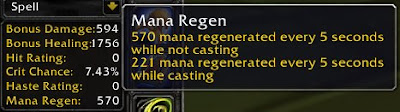
When my character FINALLY loaded and I was able to see through the lag-generated haze, I checked out that same stat: mana regeneration of 570 mp5 while not casting and 221 while casting. That is without AI present (INT: 446, SPI: 506). Later on that evening, I was able to get a friendly mage and priest to bless me with a divine spirit and arcane intellect. Mana regeneration jumped to 651 mp5 while not casting and 245 while casting.

With that much mana regeneration, I think it is unlikely that Elk will ever run out of mana even during the longest, most heal-intensive boss fights. This, of course, begs the question: Why does Blizzard feel that this change is necessary and what impact will it have on the balance of the game as it stands? Are they planning boss fights that are going to last fifteen and twenty minutes? Are mana draining abilities like viper sting and drain mana going to become less effective PvP tools? Time will tell, I guess...

Wednesday, March 19, 2008

Feral druid tanking

I am not currently a feral druid, but I levelled Elk as feral (60-70) and subsequently built a reputation as a half-way decent tank and pretty good cat DPSer. This blog article is going to contain some of my thoughts concerning the strengths and weaknesses of the feral druid, a single feral talent build that will serve both a cat and bear druid, some discussion of the attributes and stats most important to ferals; so be prepared for a relatively lengthy read.

Feral druids are comfortable in cat form or (dire) bear form. The former, acquired at level 20, will be the major DPS form the druid will find himself in while levelling all the way until he (or she) gets to the level cap. It has an incredibly fast attack speed, 1.0 sec, faster than any weapon available in game, and is limited only by the regeneration speed of his energy (20 energy every 2 seconds), much like a rogue. Bear and dire bear forms increase the armor and stamina (and hence the health) of the druid by a fixed percentage modifier. One thing not reflected in the tooltip is a 30% inherent increase in the threat generated by the bear's attacks (this means that every 100 points of damage a bear does will be perceived as 130 by mobs). These changes make the bear a very capable tank.

Threat is a very important concept to understand as a tank (or as a DPSer or healer, for that matter). Any action taken by any character in game generates threat. How much threat a character has determines whether or not a mob will attack him. A tank's job is to build threat on one or more mobs, so that they will continue attacking him while ignoring the rest of the members of his group. There are excellent write-ups on the subject elsewhere on the web (Wowwiki), so I won't go into it any more than I already have.

Tank tools are split into two categories: threat and mitigation. We have already discussed a bit about what threat is. Mitigation is equally (if not more) important to the tank. The more damage you mitigate, the less damage you take and the easier it is for your healer to keep you alive. Conversely, as you take less damage, you generate less rage and so are unable to generate as much threat since most abilities that build threat use up rage. So it's a delicate balance. When compared to warriors, beartanks have some advantages and disadvantages. Bears have higher armor and more health than equivalently geared warriors, but the warriors can parry and block so they have slightly higher overall mitigation. This, of course, is a gross oversimplification, and I may go into it in more depth in the future, but is enough for this current project.

Concepts a beartank should become comfortable with include threat and mitigation, discussed above, but one should also be aware of the numbers that feed into those concepts: attack power and crit % for threat and armor, defense/resilience and dodge for mitigation. Balancing these numbers on the character info pane is a delicate process. Here are how the numbers stack up:

2.36 defense rating = 1 defense
25 defense = -1% chance to be crit by level 70 opponent,
25 defense = +1% dodge
39.4 resilience = -1% chance to be crit by level 70 opponent,
39.4 resilience = -2% damage from crits
39.4 resilience = -1% damage from DoTs
1 agility = 2 armor
14.7 agility = 1% dodge
1 agility = 0.1% chance to crit
1 strength = 2 attack power
14 attack power = 1 dps

So what are good numbers to shoot for? 11,000-13,000 health unbuffed is not an unreasonable starting point. 24-26,000 armor is also relatively easily doable. The only magic number for a feral druid is, in my opinion, the most important one: 415 defense. Mark that one down. 415 defense. At that point, in conjunction with the talent "Survival of the Fittest", a druid tank becomes uncrittable. And because beartanks can neither block nor parry, being uncrittable becomes the single most important milestone for a newly minted 70 beartank.

The typical talent spec for beartanks is a 0/47/14. This contains all the talents necessary to tank well and many that cross over to make cat form a powerful dpser. Some time in the future, we'll talk about how to use all the tools at the disposal of the bear to grab and hold aggro.

Thursday, March 13, 2008

Cyclone nerfed

From the latest patch notes for the upcoming 2.4 patch:

Druid The range of Cyclone has been reduced to 20 yards. (was 30 yards before)

While this is not a huge change to anyone that plays a druid primarily in PvE , it comes as a major blow to the many druids that make their living in arenas and, to a somewhat lesser extent, battlegrounds. Along with the nerf to the "bloom" part of Lifebloom, it serves as a reminder from Blizzard that they are trying to balance PvP so that no one class has an overwhelming advantage. A few days ago, Kalgan (WoW lead developer) posted in the Warlock forums suggesting that in 2v2 and 3v3 arena teams that had a score over 2200, druids were overrepresented to the tune of 276% and 184% respectively (100% being what they would expect representation to be given the information they have regarding the class). By comparison, druids were *under*represented in the 5v5 category, coming in at only 80.5% (source). I don't claim to be anything resembling a PvP guru when it comes to druids. In fact, my own arena rating is extremely poor. Which is why I am rather offended when people suggest that it takes no skill to PvP as a resto druid. If it took no skill then those of us who are primarily PvE spec'd and geared, should be relatively successful in arenas, while I know from experience that this is not the case. Having stated my credentials (see last paragraph) I can still make some speculations as to why resto druids are overrepresented in some successful arena brakets and underrepresented in others:

  1. Powerful HoTs like Lifebloom and Rejuvenation can be cast on the run from 40 yards away and continue to tick for 7 to 12 seconds. This is pretty much an eternity in PvP, especially when there is not enough damage being concentrated on a single target to overcome those HoTs, like in smaller arena teams.
  2. Cyclone is a powerful, but short crowd control method that can only be broken by bubbling (paladins only) or trinketing out of it. At 30 yards, it's range is outside rogue's shadowstep or any number of other class abilities so can often be cast with impunity.
  3. Entangling Roots does not share diminishing returns with cyclone and is very effective at removing melee DPS from any given fight unless they can remove it somehow.
  4. Druids can effectively kite melee classes by switching to travel form and casting HoTs on themselves while moving.
  5. Druids are generally unable to stand up to focused fire from several characters at once, since their HoTs are unable to overcome the massive amounts of damage which they are subjected to, hence the underrepresentation in the 5v5 arena category.

Of course these are the speculations of a druid who does not often find himself in PvP situations. If anyone else has any insights, I would be glad to hear them and even include them in this article.

Tuesday, March 11, 2008

Improved Mark of the Wild vs. Furor

In the last couple of days there has been a discussion on the druid forums about the relative merits of the two top tier restoration talents. Both Furor and Improved Mark of the Wild are 5 point talents so taking points in either one will allow you access to the juicier tier 2 talents: Naturalist, Nature’s Focus and Natural Shapeshifter. Let’s look at the two talents in detail first and then we’ll get to some of the arguments made in the discussion:

Improved Mark of the Wild: increases the effects of your Mark of the Wild and Gift of the Wild by 7/14/21/28/35%. At level 70, an untalented Mark of the Wild provides 340 armor, increases all attributes by 14 and all resistances by 25. When augmented by a full 5-point IMotW this becomes 459 armor, 18 to all attributes and 33 to resistances.

Furor: Gives you a 20/40/60/80/100% chance to gain 10 Rage when you shapeshift into Bear and Dire Bear Form or 40 energy when you shapeshift into Cat Form. Normally, you would have to wait for 4 seconds after shifting into cat form to accrue that much energy and you would have to do white damage or Enrage after shifting to bear form to generate rage. The arguments made to support IMotW in the thread:

  • At least 1 druid in a raid should have it to buff the raid
  • PvE resto does not need Furor, while IMotW has its purpose in raids

The arguments made to support Furor:

  • It is indispensible in PvP for shift to bear --> feral charge combos
  • Resistances from MotW do not stack with buffs from other classes
  • IMotW is a very poor use of 5 talent points
  • Can be used to shift to cat --> cower [I do not agree than any PvE druid should ever have to do this - RE]

There was very little argument in the thread, even between those druids disagreeing about which of the talents to take. The general concensus was that Mark of the Wild is a very weak buff that scales not at all and that IMotW is a marginal talent not worth a single talent point, let alone 5. However, while MotW and IMotW are so weak, Furor provides little to no benefit for a raiding restoration-spec'd druid.

I must say that I have to concur with these assessments. Pre-Burning Crusade, MotW was a relatively strong buff, comparable with Prayer of Fortitude and Arcane Intellect. However with the advent of Burning Crusade, the buff received from the spell has become marginal, at best. In trying to do everything, it ends up contributing almost nothing. If the resistances provided by MotW stacked with those provided by other classes (totem of fire/frost resistance or paladin auras), it would be something at least. As things stand, there is little enough reason to even cast MotW, let alone spend 5 valuable talent points to give it a 35% buff.

Furor, on the other hand, contributes nothing to a raid. If a druid is engaged in endgame content and not interested in PvP, there is no reason to take this talent. So a 35% increase to something very small is preferable to nothing at all. Don't get me wrong, I think Furor is a GREAT talent. But for a druid that spends their time in 10- and 25-man raids, it has very little, if any application at all. A raid leader may ask for IMotW, but, if they are not a druid, they may be ignorant of how little it actually helps: 119 armor and +4 to all attributes is not something to write home about.

In the final analysis, it is up to each individual druid how to use their first five restoration talent points. If one is a feral, Furor is a no-brainer. For balance druids (rare as they are) IMotW is marginally more useful than the nothing they get from Furor (unless they pvp). Restoration druids have to make the choice between a talent that is useful only to them or one that has a marginal usefulness to their raid.

Monday, March 10, 2008

Lifebloom nerf reversed

In the last patch notes available for the 2.4 PTR, the druid section read:

Lifebloom: The bonus coefficient on the final bloom effect has been reduced by 20%. This spell will no longer cause error messages when interacting with Spellsteal or while the Druid is under the effects of Mind Control. Regrowth: The mana cost of this spell has been reduced by approximately 20%.

Being primarily a PvE healy druid, I am very happy with this change. The HoT aspect of Lifebloom remains unchanged, while the bloom is nerfed somewhat. As I explained before, the HoT is very important to druid raid healing because we can roll it (meaning, continually refresh a stack with minimal effort) on several tanks, while the final bloom is much less of an issue. This is a much more serious development for druids that are a lot more into PvP. The final bloom is always an issue since players have many different ways of keeping themselves alive and can survive, long enough for that final bloom to be a lifesaver, even though the 200 or so health provided by the HoT every second is not as important. If my reasoning is flawed here, please forgive me; my PvP skills and knowledge is sadly lacking.

The second change is something that I would like to touch on also: the cost of regrowth has been reduced by 20%. Regrowth has long been a bane of the resto druid's mana pool. At a whopping 845 mana, it can chew through a large mana pool in seconds. This change sets the cost at 540 mana if cast while in tree form. This is a HUGE change. The spell suddenly grows a lot more attractive to use in long boss fights when it would normally be overlooked. Phae, over at resto4life (the definitive resto druid blog, check it out if you haven't already) has an interesting analysis of it here:

http://www.resto4life.com/2008/03/09/regrowth-the-new-raid-heal/

Phae makes some rather compelling arguments for using regrowth a LOT more than we currently do. I tend to agree, but don't think we will be scrapping rejuvenation or lifebloom any time soon

Wednesday, March 5, 2008

Say NO to the lifebloom nerf

I am joining this blog to the growing number of druid blogs out there that are opposed to the upcoming nerf to lifebloom that Blizzard is contemplating for deployment in patch 2.4. http://www.leafshine.net/2008/02/bloggers-agains.html At first glance, the 8% decrease in the value of the HoT tick is not anything to whine about, but consider this: RunningElk's lifebloom currently ticks for around 224 every second. When three-stacked (as it normally is on tanks) it ticks for 675 or about 750 if the tank is in my group and benefitting from my 600+ spirit (raid-buffed). Fully stacked lifeblooms are the main source of the healing I provide a raid or 5-man group. An 8% decrease in the tick value will result in a 3-stack of lifebloom ticking for 618 (with tree buff) or 690 (without tree buff). Assuming that I am rolling lifeblooms, as I should be, and that I keep full lifeblooms stacks up on two tanks (which is easy) or three tanks (tougher), my healing output will be significantly compromized. In order to get back to where I am now, I would have to upgrade my gear to Black Temple levels, i.e. +healing over 2000 unbuffed. Frankly, I don't think it's reasonable to nerf a core PvE ability in order to fix a perceived PvP imbalance, especially in a way that does nothing to the way that ability is used in PvP.